

Inconel vs Titanium for Valves: Key Differences, Limits & Selection Guide
60-Second Quick Summary
- Choose Inconel if your valve sees continuous high temperature, hot corrosives, Class 600+ cyclic duty, or throttling wear / galling risk.
- Choose Titanium if your valve is mainly for seawater / chloride-rich service or weight-sensitive installations, and temperature stays within titanium limits.
- Critical note: Titanium performance depends heavily on crevice design (flanges/gaskets/stagnant pockets). Inconel is less sensitive but higher cost and heavier.
- Practical tool: Use the checklist in Section 5 to lock your purchase spec.
About the Author
This guide is prepared by NTVAL’s Valve Materials Application Engineering Team, focused on special-alloy valve selection, fabrication QA, and corrosion failure analysis for industrial projects.
Learn more about our engineering and QC capability here: About NTVAL / Engineering and Quality Control / Testing.
Inconel vs Titanium: What’s the Difference for Industrial Valve Applications?
Inconel vs Titanium is a practical decision for industrial valves operating under corrosion, temperature, pressure cycling, and weight constraints.
- Inconel (commonly 625 / 718) is typically preferred for extreme heat, oxidation stability, hot corrosives, and cyclic high-pressure service.
- Titanium (Grade 2 / Grade 5) is often selected for seawater / chloride environments and weight-sensitive systems, within its temperature and crevice-design limits.
This guide compares the two materials specifically for valve use cases: operating envelopes, failure modes, fabrication/QA, and procurement checklist.
1. Why Material Selection Matters in Valves
Valve material selection affects:
- Pressure boundary integrity and safety margin
- Seat sealing stability under ΔP and cycling
- Resistance to galling in trim components
- Crevice corrosion risk in flanged joints and stagnant zones
- Maintenance interval and unplanned downtime cost
In practice, valves fail not only because of “corrosion resistance,” but because of combined mechanisms: temperature + chlorides + crevices + cyclic operation.
2. What is Inconel?
Inconel is a family of nickel-chromium-based superalloys used for high-temperature strength and corrosion resistance.
Common Inconel grades used in valves
- Inconel 625: strong general corrosion resistance, commonly selected for harsh chemical and mixed environments
- Inconel 718: higher strength/fatigue resistance, often used for high-stress trim or stem-related components
(Other grades may be used based on project spec.)
If you’re sourcing special-alloy valve options, see: Special Material Valves.
3. What is Titanium?
Titanium alloys are lightweight metals with strong corrosion resistance—especially in many chloride environments.
Common titanium grades used in valves
- Grade 2: widely used for seawater/chloride service
- Grade 5 (Ti-6Al-4V): high strength-to-weight ratio, used where weight and strength both matter
4. Comparative Analysis: Inconel vs Titanium for Valves
| Criteria | Inconel (typ. 625/718) | Titanium (Grade 2/5) | Valve-specific note |
|---|---|---|---|
| Density | Higher | Much lower | Titanium reduces installation load |
| Continuous temperature | Higher (grade dependent) | Lower (grade dependent) | Titanium is not for sustained extreme high-temp steam |
| Chloride / seawater | Good (grade dependent) | Excellent (service dependent) | Titanium often preferred for seawater intake/desalination |
| Galling / throttling | Stronger | Needs care | Titanium throttling may require hardfacing on trim |
| Fabrication cost | Higher | Usually lower | Inconel machining/welding often more demanding |
| Best-fit logic | extreme heat / cyclic / hot corrosives | seawater/chloride / weight | Use checklist in Section 5 |
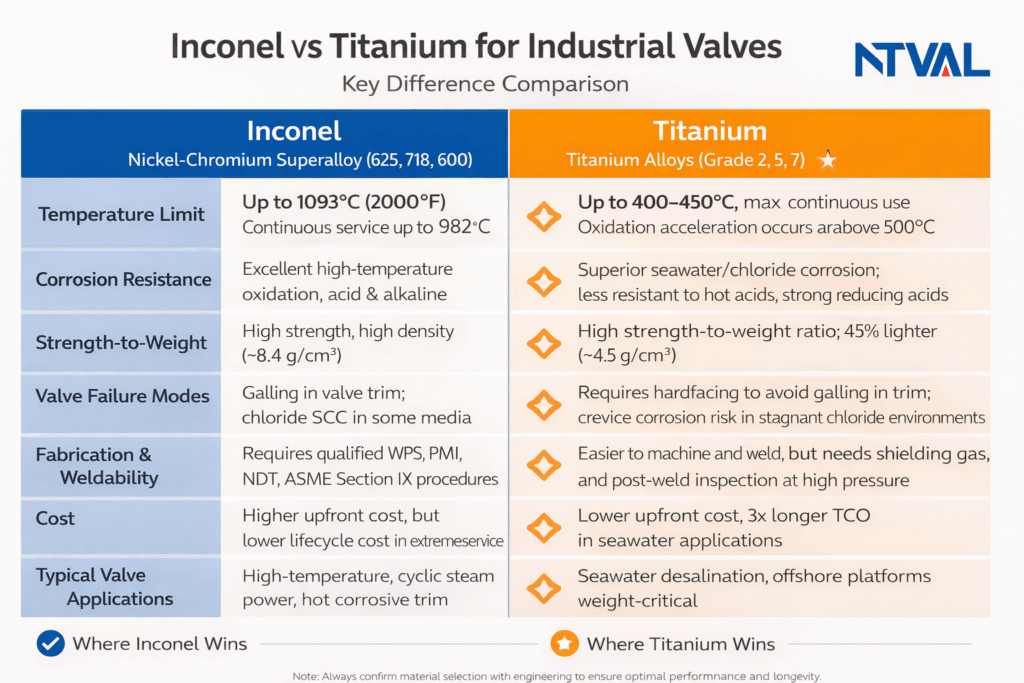
4.1 Valve Operating Envelope Boundaries
Choose Inconel when:
- continuous temperature is beyond titanium’s safe range
- hot corrosive media and thermal cycling dominate risk
- Class 600+ and frequent cycling increases fatigue and galling risk
- you need stable performance under long-term severe service
Choose Titanium when:
- seawater/chloride is the main driver
- you need weight reduction for platforms, mobile units, or systems with structural constraints
- design can control crevices and stagnant pockets (flanges, gaskets, cavities)
4.2 Common Valve Failure Modes & Material Behavior
1) Galling / wear in trim
- Inconel is generally more tolerant of cyclic metal contact.
- Titanium may require trim hardfacing or surface strategy if throttling is involved.
2) Crevice corrosion in flanges / gaskets / stagnant pockets
- Titanium performs very well in open seawater exposure, but crevice design is a critical variable.
- Good practice: reduce dead zones, ensure proper gasket coverage and bolting control.
3) Thermal fatigue / temperature cycling
- Inconel is generally preferred when repeated high-temperature cycles occur.
4) Hydrogen-related risks
- Titanium service in cathodically protected systems or special chemistries should be reviewed case-by-case.
4.3 Fabrication & QA Considerations
For special-alloy valves, purchasing should include fabrication and QA controls, not just material name.
Recommended QA package:
- MTR / Heat traceability (mill test report)
- PMI (positive material identification) for pressure boundary and critical trim
- NDT as required (PT/UT/RT per project spec)
- Hydrostatic + seat test per applicable valve test standard
- WPS/PQR availability for welded constructions if required
4.4 Typical Valve Applications
Inconel valves are commonly selected for:
- High-temperature steam / thermal processes
- Hot corrosive chemical services
- High-pressure cyclic duty where galling/fatigue is a risk
For details on valve types available in Inconel materials, see Inconel Valves Product Page .
Titanium valves are commonly selected for:
- Seawater intake, desalination, offshore utilities
- Chloride-dominant media where corrosion drives lifecycle cost
- Weight-sensitive installations (platforms, marine, certain mobile systems)
For details on valve types available in Titanium materials, see Titanium Valves Product Page .
If you’re comparing check valve options by service, see: Check Valve Types / Manufacturer.
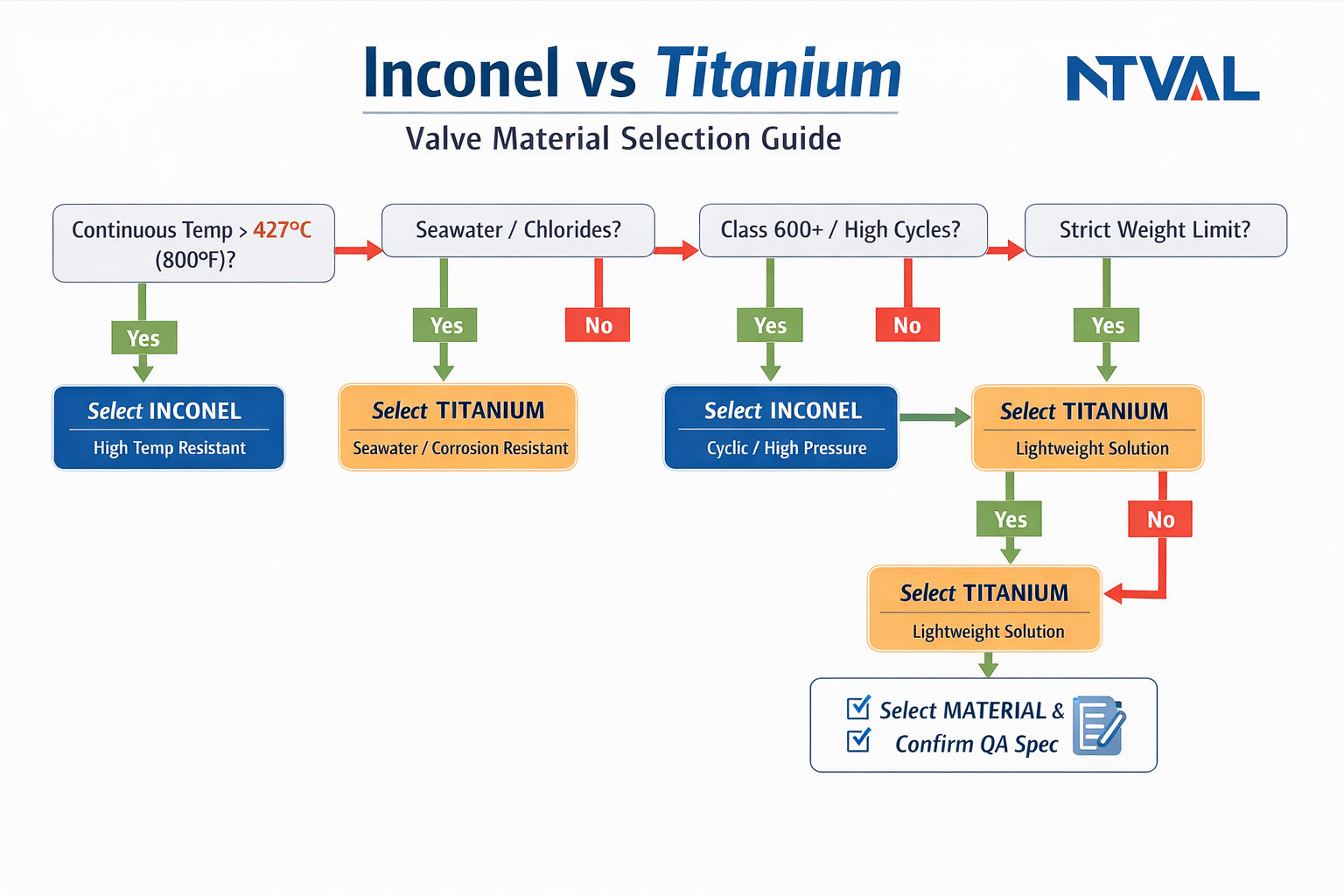
5. Valve Material Selection Checklist: Inconel or Titanium
Use this checklist as a procurement filter:
- Continuous operating temperature
- Above titanium safe range → choose Inconel
- Within titanium range → move to media and crevice risk
- Primary corrosion hazard
- Seawater / chloride-rich → Titanium is often preferred
- Hot acids / oxidizing high-temp → Inconel is often preferred
- Pressure class & cyclic duty
- Class 600+ cycling / frequent operation / throttling → bias to Inconel
- Weight constraint
- Offshore/mobile/structural load constraint → bias to Titanium
- Compliance & QA documentation
Confirm whether the project requires:
- ASME valve design basis, sour service compliance, pipeline valve requirements, third-party witness, etc.
6. Lifecycle Cost (TCO): When “More Expensive” is Actually Cheaper
Upfront cost alone is often misleading. A simple TCO view:
| Cost driver | Inconel | Titanium | Typical reality |
|---|---|---|---|
| Upfront material + machining | Higher | Often lower | Inconel often costs more to process |
| Maintenance frequency in severe service | Lower | Depends on crevice/throttling | Wrong titanium design can raise maintenance |
| Failure risk in extreme temperature/cycling | Lower | Higher | Titanium not for sustained extreme heat |
| Best TCO scenario | extreme service | seawater/chloride utilities | Pick based on the dominant failure mechanism |
7. What NTVAL Can Supply (Capability Statement)
NTVAL supplies special-material industrial valves with QA support, including:
- Valve types: gate / globe / ball / check / butterfly
- Material options: Inconel (selected grades), Titanium (Grade 2/Grade 5), and other special alloys
- Documentation: MTR, PMI, NDT options, hydro/seat test records (per project requirement)
Steam and power-related accessories: Steam Trap
Conclusion
For Inconel vs Titanium in valve applications, the decision is driven by:
- temperature envelope
- corrosion mechanism (especially chlorides + crevices)
- cyclic duty / throttling wear
- weight constraints
- QA and compliance requirements
If you share your operating temperature, media, pressure class, and valve type, our engineering team can provide a material suitability suggestion aligned with your procurement checklist.
Frequently Asked Questions
1) Which is better for seawater valves: Inconel or Titanium?
Titanium is often preferred for seawater/chloride environments, but flange/crevice design is critical. In some mixed conditions, Inconel may be chosen for stability against cycling and wear.
2) What is the maximum operating temperature for titanium valves?
Titanium temperature capability depends on grade and environment. For continuous service, titanium is generally used at lower temperatures than Inconel; confirm exact limits by grade and project spec.
3) Is Inconel more expensive than titanium for valves?
Usually yes on upfront cost, because Inconel can require more demanding fabrication. But in extreme service it may reduce failures and total lifecycle cost.
4) Which material is better for high-pressure valve trim?
Inconel (commonly 625/718 families) is frequently selected for high-stress or cyclic trim components due to wear/fatigue considerations.
5) Can titanium valves be used for throttling service?
Yes, but throttling may require trim hardfacing or surface strategy. Unprotected titanium can wear faster under repeated metal-to-metal contact.
6) How do you mitigate crevice corrosion risk in titanium valves?
Use better gasket coverage, eliminate stagnant pockets, control bolt torque, and minimize dead zones in body/flange design.
7) Which material has better weldability for valve fabrication?
Titanium can be easier in many general cases, but requires clean welding control. Inconel welding and machining can be more demanding; qualification and QA are important for both.
8) Are Inconel and titanium valves suitable for sour service (NACE MR0175)?
Some grades can be used, but it depends on hardness limits, environment severity, and project requirements. Confirm compliance by grade and documentation.
9) What QA documents should I request for special-alloy valves?
At minimum: MTR + heat traceability, PMI for critical parts, hydro/seat test records. Add NDT and third-party witness if your spec requires it.
10) What information should I send to get the correct material recommendation?
Valve type, size, pressure class, operating temperature (continuous + peak), media composition (chlorides/acid/sour), duty (on-off vs throttling), and compliance requirements.
—
### Document Control
Revision: 2026.03
Last Reviewed: March 2026
Reviewed by: NTVAL Valve Materials Application Engineering Team
This document has been updated to reflect refined temperature boundaries, fabrication QA considerations, and lifecycle cost evaluation for industrial valve applications.


